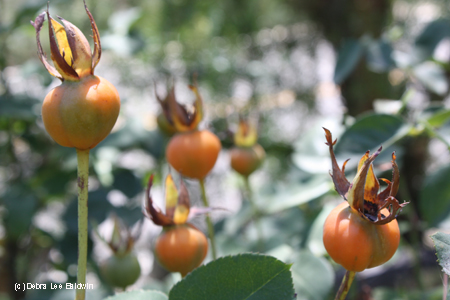
Autumn is a good time to look at the garden in terms of wabi-sabi, the Japanese aesthetic that finds beauty in imperfection and transience. In seeking wabi-sabi, one cultivates an appreciation for the ordinary and becomes aware that age offers its own poignant beauty. Because wabi-sabi evokes a feeling, it sometimes is defined as the ability to see the invisible. For me, it’s savoring what normally is ignored.
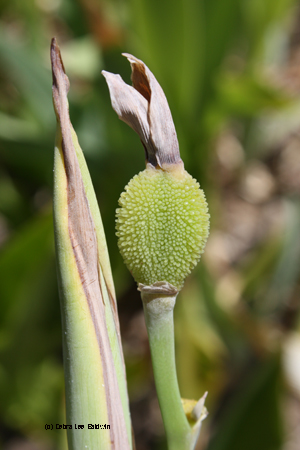
In my summer garden, cannas produce fountains of orange and yellow petals. When the jazzy flowers are gone, the green, thumbnail-sized seedpods have a quieter appeal.
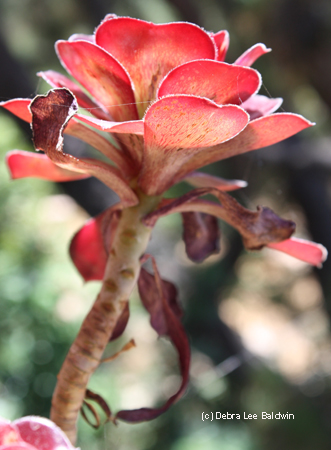
The lower leaves of aeoniums dry and curl, and are so delicate, it’s amazing they manage to linger.
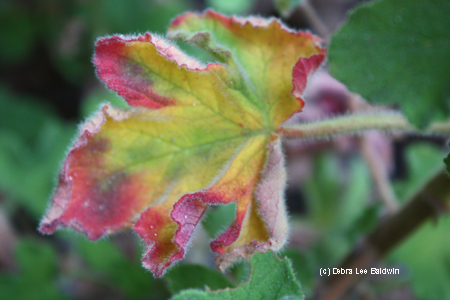
None of my trees turn fall colors, so when I see something like this, I’m delighted. It’s a fuzzy mint geranium leaf.
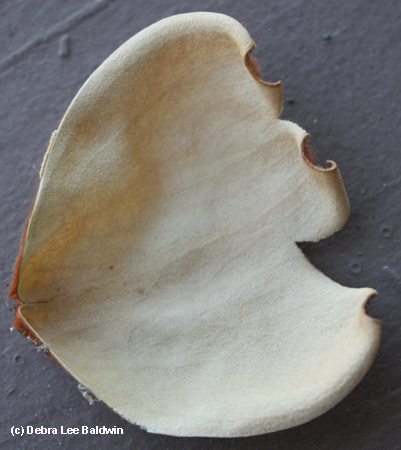
A fallen magnolia petal is as dry and crisp as a potato chip. I like its creamy color and the way the edge curls. The other side is red-brown velvet.
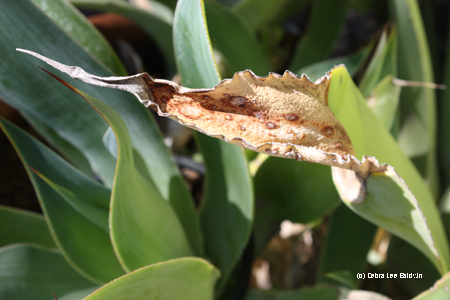
After an Agave attenuata leaf was damaged, the tip shriveled. (I considered using this as the first photo above, but I was afraid someone might assume wabi-sabi is a leaf disease!)
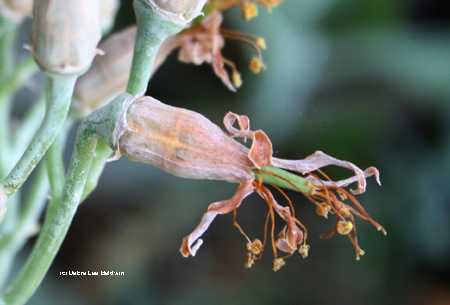
A dried Cotyledon orbiculata blossom suggests an uncorked champagne bottle.
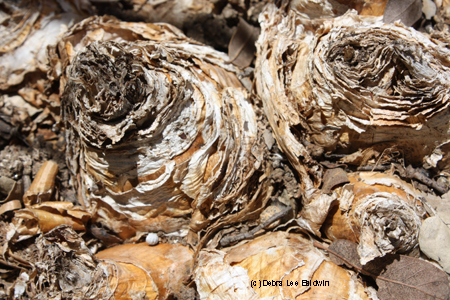
Amaryllis belladonna bulbs are as large as onions. These look like they need to be buried, but they’re fine partially exposed, in fact, they prefer it. I like the touching the bubs’ papery exterior, admiring their concentric symmetry, and being in on the secret that each produces stunning pink lilies.
(I took the remaining photos in Georgetown, Colorado.)
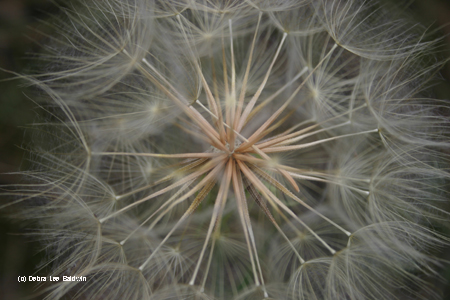
This seedhead—of a weed growing in a field—is teacup-sized.
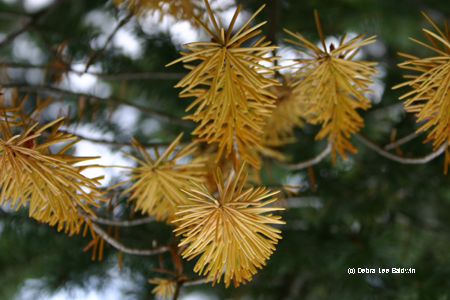
These pine needles caught my eye because of their shockingly sunny hue.
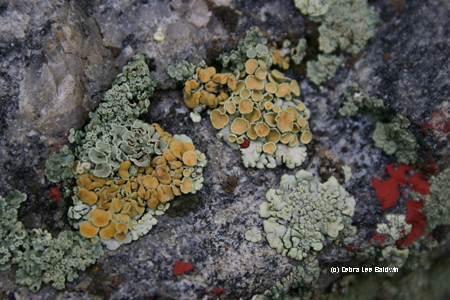
Lichen, growing on a boulder.
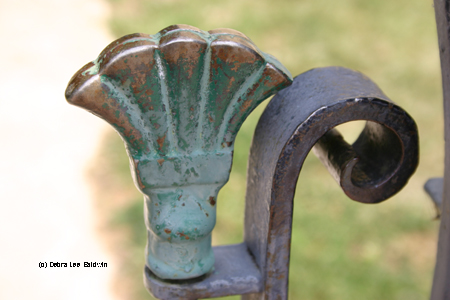
As exemplified by this gate finial, wabi-sabi need not be limited to plants.
Next time you’re in your garden, instead of rushing to finish pre-winter chores, slow down and observe the beauty in things that are aging, imperfect and transient. Let us know what you find.


17 responses so far ↓
1 Lisa at Greenbow // Oct 17, 2009 at 5:15 am
Wabi-sabi, I like this description of the garden for this time of year. I didn’t know what it meant but it is one of those words that feels good and has a lot of substance.
Hi, Lisa — I agree. Wabi-sabi is such a great concept. Now that you know it, you’ll see it everywhere. I hope my post somehow managed to convey wabi-sabi’s lovely poignancy. Debra
2 elizabeth ~ so wabi sabi // Oct 17, 2009 at 6:46 am
for obvious reasons the post resonated with me…these were lovely examples.
Hi, Elizabeth — Oh, my goodness, your blog celebrates wabi-sabi! How cool is that? I like your description:
“finding beauty in ordinary places…natural, handmade, homemade, homegrown, goodness, shared with love”
Debra
3 Darla // Oct 17, 2009 at 7:39 am
Wabi-sabi–is perfect! I love all of the added interest from different plants in the fall/winter garden.
Hi, Darla — In some ways, I like the winter garden best. If I’m on top of things, everything is tidy, trimmed back and mulched. Plants refreshed by rainstorms are growing roots in preparation for spring growth. Debra
4 Sue in Milan // Oct 17, 2009 at 7:54 am
Super photos. They show that every season is beautiful – just in different ways.
Thanks, Sue. I love that you’re in Italy. The way that GGW reaches an international audience amazes me. What a great gardening community we have! Debra
5 Pam Kersting // Oct 17, 2009 at 9:15 am
I like this very much and agree whole-heartedly! We must stop and smell the roses, even if the roses are wabi sabi! Lovely photographs too.
Hi, Pam — Re smelling the roses: Rose hips look great in fall arrangements and centerpieces. They can even simulate mini-pumpkins! Debra
6 GardenRetreat // Oct 17, 2009 at 9:52 am
I need the reminder to not let my garden become the enemy during the fall season.. thanks for the encouragement
I know what you mean. I don’t like to have people visit the garden in fall because it’s so ratty looking after many months of dry heat. I have to discipline myself not to continually make excuses: “You should have seen it earlier,” or “It’ll look so much better later on…” Debra
7 Little Wing // Oct 17, 2009 at 7:14 pm
You’ve introduced me to a new term. I like it. My gardening style is very relaxed so I can find plenty of wabi-sabi here and I enjoy it all. Beautiful post!
Hi, Little Wing. Thank you! Your blogsite is lovely, btw. Exquisite photos. Debra
8 Kylee from Our Little Acre // Oct 18, 2009 at 2:23 pm
Debra, I love this. I’m taking you up on your suggestion of finding wabi-sabi here at Our Little Acre. It will be fun to see things in a little different way, and a fun assignment. Stay tuned!
Kylee, I am so delighted at your 10/18 post on wabi-sabi in your Ohio garden. Your photos are amazing. I’m very pleased to have inspired you to look at your autumn garden in such a fresh and creative way. I hope everyone who reads this will visit your blog and enjoy your interpretation of wabi-sabi. Well done! Debra
9 Gary // Oct 18, 2009 at 10:42 pm
Wonderful images! I would love to see the “red-brown velvet” on the other side of the Magnolia.
Thanks, Gary. That magnolia petal is long gone, unfortunately. Debra
10 Blackswampgirl Kim // Oct 18, 2009 at 10:49 pm
I love this post… which captures all of the quirky little things that I seem to tend to notice in my own garden, too. And since “wabi-sabi” is my decorating “personality,” I intend to take you up on this challenge of sorts.
Hi, Kim — I agree. A garden shouldn’t be taken too seriously. We’re never completely in control of it, and sometimes it’s the things we don’t plan that can be the most rewarding. Debra
11 Kylee from Our Little Acre // Oct 18, 2009 at 10:52 pm
Debra, I thoroughly enjoyed the exercise you presented. The results of my effort can be found here.
Yes, Kylee, it’s terrific. Bravo! Debra
12 Marlene // Oct 19, 2009 at 10:11 am
Thanks for a great post, Debra. It reminded me of a fall hike taken many years ago with an elderly friend of ours. He stopped and cut a stem of common Canada goldenrod, snipped off the flowerhead and stripped the foliage, leaving a bare stem that sported an insect gall. He made this the focal point of an impromptu flower arrangement, but he also taught me to see the extraordinary in the commonplace.
Hi, Marlene — What a great memory…and a great phrase: “seeing the extraordinary in the commonplace.” Thanks for sharing! Debra
13 jodi (bloomingwriter) // Oct 20, 2009 at 7:34 am
Debra, I so needed this post to help inspire me, because we’ve had nothing but dreary, cold, wet, windy weather for about two weeks. So now I’m suitably rethinking my attitude and heading out to the garden to do my own exercise. Thank you for your wise words.
Hi, Jodi — I’m very pleased that the concept of wabi-sabi brightened the way you view your rain-soaked garden. Debra
14 Benjamin // Oct 23, 2009 at 11:26 am
And perhaps wabi-sabi is, in fact, kokoro? Makes me think more about Japanese design principles we can use in our American / hodge podge gardens.
Hi, Ben, you have me intrigued. How do you interpret kokoro in terms of gardening? I understand (from Google) that it’s difficult to define, but can be translated to mean “heart.” Debra
15 Benjamin // Oct 24, 2009 at 6:35 pm
I think I define kokoro as somethign more undfinable, an absence, an emotional or even psychological awareness of the garden’s character or even organizing principle. Landscapes give off different ‘hearts,’ I think, differnet vibes is maybe a way to say that. So perhaps kokoro is a je ne sais quoi factor, soemthing we can’t neessarily predict as we put together a piece of art. Maybe it’s divine breath?
16 jodi (bloomingwriter) // Nov 2, 2009 at 8:22 pm
I probably get the booby prize for being the latest participant, but I finally have my post on wabi-sabi in my garden up at http://tinyurl.com/ybdxhqx
Jodi, your post on wabi-sabi in your Halifax garden is wonderful—pure poetry. I’m delighted to have inspired you.
An excerpt from Jodi’s post: “Beauty in imperfection and transience. That really resonated in my soul. We’re a culture that seems to seek perfection, though what defines perfection varies with each of us. I thought about this for a while, and went back outside to look at the garden again with more open and less critical eyes. There is a lot of beauty out there, when one takes time to look at things a little differently.”
And this as well (with a great photo): “Seedheads of this exuberant clematis look like cheerleader pompoms or floral fireworks, celebrating the season’s finale. The way they catch and reflect light when the sun deigns to find us makes me deliciously gleeful.”
A good post makes you feel like you know the blogger better and have visited her garden. Good job, Jodi! Debra
17 Sue Betten, South Haven, MI // Dec 1, 2009 at 11:57 pm
Love it!! Thank you.
Sue Betten,
shteacher@rocketmail.com,
“Wabi Sabi Sue”
Ha! I love “Wabi Sabi Sue” (sounds a lot better than “Wabi Sabi Debra.”) I see you’re on Facebook, Sue, and will send you a friend request.
Leave a Comment