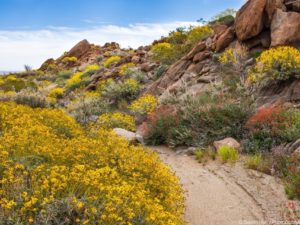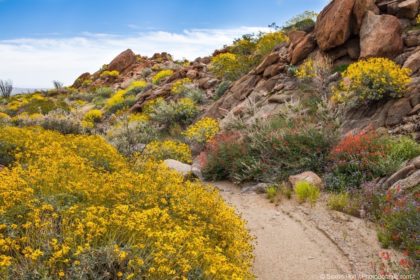
I love the way aloes brighten Southern California gardens this time of year. Shown above is the most widely grown aloe, Aloe arborescens. The location is about halfway between San Diego and Los Angeles, in Laguna Beach. This is an artist’s enclave, and not surprisingly, aloe flowers against blue sea and sky are a popular subject for paintings.
Depending on the species, aloe flower spikes can range from several inches in height to several feet. The blossoms most often are orange, but also may be crimson, cream, rose, yellow or combinations.
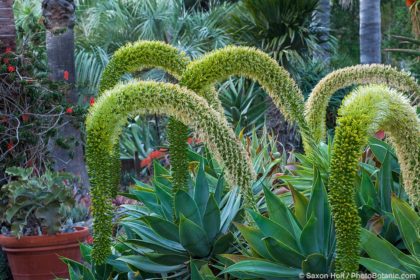
Buds along the flower spike open from the bottom up. When these are tightly closed at the top and full-blown at the bottom, the stalk looks fringed and conical. Aloe ferox (above), with 3-foot, candelabra-like stalks, is among the most spectacular. Those of equally dramatic Aloe marlothii (below) are more horizontal—they remind me of feathers.
Aloes are succulents, plants that by definition store water in fleshy leaves and stems in order to survive periods of drought. Aloes, which are from Madagascar, the Middle East and South Africa, grow readily in frost-free regions that have minimal rainfall. Too much moisture can cause the trunks and roots to rot. Aloes are not fussy about soil, as long as it is fast-draining. In my north San Diego garden, aloes thrive in nutrient-poor decomposed granite soil. A rule of thumb is to let soil go nearly dry between waterings.
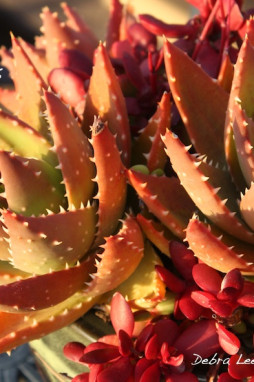
Aloe vaombe (above) has upright crimson blooms above large leaves that are dark green to brownish-red, and that are lined with white teeth.
Rather than spires, the blooms of Aloe striata (coral aloe, above) form branching clusters.
All aloes have gel-filled leaves. The best known aloe, Aloe vera (below), often is grown as a windowsill plant in kitchens because the gel soothes minor burns. It is not the only medicinal aloe, merely one of the most juicy.
Aloes are beautiful in combination with other succulents. The colorful bed shown below has a carpet of variegated Portulacaria afra behind Aloe cameronii in bloom.
Aloes also are wonderful for wildfire-prone areas. When arranged around a garden’s perimeter, they can serve as natural firebreak. A stand of Aloe arborescens protected the house on the cover of my book, Designing with Succulents, from burning during the wildfires of 2007. I wrote about this for the Los Angeles Times. The story, “Did Succulents Save Her Home?” is on my website, www.debraleebaldwin.com.
If you live in a colder climate, Hardy Succulents, photographed by one of the nation’s finest garden photographers, northern CA resident Saxon Holt, is an outstanding resource. Also see Saxon’s Gardening Gone Wild post on Hardy Succulents in California.


so many beautiful pics and aloes! the first kind is very common here in portugal: they are beautiful but kind of invasive, on small scale of course…
i didn´t know Aloe marlothii which is gorgeous and a lot different from the more common ones, i must look for one of those… ;p
Aloes are Old World plants—they’ve grown in Portugal a lot longer than here in the Americas. I’d love to know who first introduced them to Southern California! Debra
Wow! Those are spectacular! You’re right, they’re even more stunning against those beautiful blues.
Blue and orange do combine beautifully in the garden. Another great combination (using succulents) is orange Euphorbia tirucalli ‘Sticks on Fire’ underplanted with blue Senecio mandraliscae. And Nancy, I checked out your website, and your own photography is spectacular! Debra
Those are some gorgeous aloes. The form on the Aloe vaombe is very architectural and the blue and coral of the ferox is gorgeous. Right now my aloe vera, maculata and ciliaris are in bloom. I am actually converting people to aloes when they see my maculata in bloom-most people here in the Caribbean only know of aloe vera.
Last May, in San Francisco, I got some small A. cameroni, marlothii and aculeata-there is only so much I can carry in my hand luggage. I can’t wait for the marlothii to look anything like that pic. On my next trip I want to get a couple plicatilis.
Nicole-
Aloe plicatilis, which has leaves that resemble tongue depressors (they’re arranged like fans on the ends of limbs), makes a great little tree. Remember to keep its soil dry in summer and wet in winter. I love your website, Nicole—and it’s very cool to hear about the aloes you grow in Trinidad!Aloe plicatilis, which has leaves that resemble tongue depressors (they’re arranged like fans on the ends of limbs), makes a great little tree. Remember to keep its soil dry in summer and wet in winter. I love your website, Nicole—and it’s very cool to hear about the aloes you grow in Trinidad! Debra
Ah, plant lust. These pictures make me want to move to California. As it is, we make due by growing hardy and non-hardy succulents in containers here in the great white north.
Yvonne-
Oh! Your photos of your winter garden (in Ontario, Canada) on your blog are so gorgeous! And hey, every region has its challenges. Here in SoCA, another winter with minimal rainfall means water rationing is a near certainty. Just yesterday I noticed another parking strip that had been replaced by fake turf—which strikes me as both funny and sad. Debra
Who knew that tired old plant sitting in the kitchen window could be so lovely. My favorite shown is A. marlothii, it reminds me Crocosmia flowers, but only showier.
Les-
You’re right—the flower form of crocosmia does indeed suggest the aloe’s, in miniature. Debra
Hi Debra.
I want to say congratulations on your book. I got it for Christmas and it has been loitering (in a good way) around my chair ever since. I have been inspired by so many of the images in it, finding myself creating more and more succulent and cacti beds…(perfect for Texas). I have also found it a great reference for identifying some of my succulents that had lost or discarded tags!Great work. Tell me you are going to do a follow up?
Regards.
ESP.
Hi, ESP! Thanks for asking—my next book “Succulents in Containers” is a Timber Press spring, 2010 release. Hey, I see from your blog you’re in east Austin. On March 18 I’m giving my “Designing with Succulents” presentation to San Antonio’s cactus and succulent society (if you’re interested, email me, Sunwriter7@cox.net). Your blog is a hoot…I love the tight shot of the red-toothed agave paired with a photo of Bella Lugosi: “So, that is vere I left them!” Debra
Hi Debra,
I was hoping to introduce myself to you at the GWA convention last year but missed the opportunity. I enjoyed your book and often take it to garden design meetings with my clients when discussing succulents in the garden! Great work.
The photos of the aloes in your post are fantastic and motivate me to add some to my garden…I have the room. Thanks for the information as well.
Shirley Bovshow
I’m so glad you like my book—quite a compliment coming from a landscape designer/TV show host! I’m sorry we missed each other at the Garden Writers symposium. I love your use of stone in your own garden, and the photos on your blog of its sunlit grasses and phormiums. Let us know when you add some aloes, OK? Debra
Oh jeez, that’s right ! the Aloes are blooming down your way. Nice shots. wish I were there. and despite my brain saying we need rain, the blue skies make me want to go to the beach
Saxon
Indeed, aloes in bloom are prettier than runway models, and as photogenic. It also helps that this time of year the light is slanted, and our rain-washed days crisp and bright. Debra
Fabulous photos of some of my most favorite plants !
Wonderfully rich colors , forms and textures.
Love those Aloes !
Thank you, Michelle! I loved your exhibit at the 2008 San Francisco Flower & Garden Show, btw—you do terrific design. (And no wonder you love aloes, you use those same colors beautifully). Debra
Thanks for visiting my blog and directing me to your wonderful posting of aloes. I am in love with these plants; they are everywhere around us. Now in La Jolla for a few days I know we are going to see even more. Plan to go to the Botanical Garden today, but as yet have not found any more gardens to visit. It would be a dream to garden here. I saw ESP had mentioned your book on succulents in post. Must look for “Succulents in Containers” as I am taking a few back with me to Texas. T
WOW… the blue skies sure do work its’ magic on those fabulous blooms! Thanks for sharing.
SLURP! GULP!
You do it EVERY time! You make me want to drop everything and RUN to buy more succulents – and when I get the aloe jones – watch out!
You are a wonder of hort-inspiration, Debra! We are so lucky to have you literally at our fingertips – thank you for such great aloe beauty shots, fab info, and for being the best succulent guru a girl could have!
XOIvette
Ha! And you make me LOL every time, Ivette. I’m glad I could show your lovely garden in “Designing with Succulents.” Debra
I live on a farm and we have an amazing variety of the most beautiful aloes, we are attempting to tame our garden and would like to know if you could help us to contact people who also appreciate the beauty of the aloes and would be interested in buying aloes and seeds.
thanking you
Hi, Tracy-Lee — Where are you located, and do you have a website? Contact me directly from my website, http://www.debraleebaldwin.com. Regards, Debra Lee Baldwin
could we send you some photos of our aloes